Provider Repositories
In a provider repository setup, each provider stores the contracts/specifications that it provides in its own repository. Consumers then point directly to that provider repository.
Provider Repository Example
catalog-serviceprovides the contract atspecs/openapi.yamlweb-bffprovidesspecs/schema.graphqland consumes thecatalog-servicecontract from thecatalog-servicerepository
catalog-service
catalog-service is the provider.
It owns the contract locally in its own repository, and its specmatic.yaml uses a filesystem source that points to the specs/ directory.
This is how the specmatic.yaml looks:
systemUnderTest:
  service:
    $ref: "#/components/services/catalogService"
components:
  sources:
    localSpecs:
      filesystem:
        directory: specs
  services:
    catalogService:
      definitions:
        - definition:
            source:
              $ref: "#/components/sources/localSpecs"
            specs:
              - spec:
                  path: "openapi.yaml"
To learn more about specmatic.yaml, see Specmatic configuration.
web-bff
web-bff is also a provider repository, but in this example we are looking at it as a consumer of catalog-service.
In its specmatic.yaml, it:
- uses a local filesystem source for its own GraphQL contract
- points to the
catalog-serviceGit repository for the provider-owned OpenAPI contract
systemUnderTest:
  service:
    $ref: "#/components/services/webBff"
dependencies:
  services:
    - service:
        $ref: "#/components/services/catalogService"
components:
  sources:
    localSpecs:
      filesystem:
        directory: specs
    catalogServiceRepo:
      git:
        url: https://github.com/specmatic-demo/catalog-service
  services:
    webBff:
      definitions:
        - definition:
            source:
              $ref: "#/components/sources/localSpecs"
            specs:
              - spec:
                  path: "schema.graphql"
    catalogService:
      definitions:
        - definition:
            source:
              $ref: "#/components/sources/catalogServiceRepo"
            specs:
              - spec:
                  path: "specs/openapi.yaml"
Repository flow
Both repositories in this example produce two different report types:
- a Spec Metadata Report
- a service build report
Spec Metadata Report
Generate the Spec Metadata Report
central-contract-repo-report is deprecated. Use spec-metadata-report instead. The deprecated command remains available as a compatibility alias.
Please ensure the repository Git root is mounted into the container.
Run this from the provider repository root, while setting the container working directory to the specs/ folder:
docker run --rm -it \
  -v "$(pwd):/usr/src/app" \
  -v ~/.specmatic:/root/.specmatic \
  -w /usr/src/app/specs \
  specmatic/enterprise \
  spec-metadata-report
This generates the Spec Metadata Report at:
build/reports/specmatic/spec_metadata_report.json
Run specmatic spec-metadata-report --ci with build and repository metadata to generate and publish this report. See Reports Sent to Insights for the JSON payload.
Service build report
Start the service
Start the service using Docker or your usual startup method:
docker compose up --build
Run the contract test suite
Please ensure the repository Git root is mounted into the container.
In another terminal:
docker run --rm -it \
  -v "$(pwd):/usr/src/app" \
  -v ~/.specmatic:/root/.specmatic \
  -w /usr/src/app \
  specmatic/enterprise \
  run-suite
For repositories such as web-bff that both own a local contract and consume provider-owned contracts, run-suite will start the dependency mocks and then run the contract tests.
In this example:
-
catalog-serviceproduces:build/reports/specmatic/test/html/index.htmlbuild/reports/specmatic/test/ctrf/ctrf-report.json
-
web-bffproduces:build/reports/specmatic/graphql/test/html/index.htmlbuild/reports/specmatic/graphql/test/ctrf/ctrf-report.jsonbuild/reports/specmatic/stub/html/index.htmlbuild/reports/specmatic/stub/ctrf/ctrf-report.json
To learn more about contract testing, see Contract Testing.
CI Workflows
PR Process
Pull requests should run the usual pre-merge checks for contracts/specifications before they are merged.
To learn more about the shared PR process for contract repositories, see PR Process.
Posting reports to Insights
Publish reports to Insights only from workflows that run on push or merge to main.
Repository workflow
For a repository that owns a contract/specification:
- Generate the Spec Metadata Report
- Publish the Spec Metadata Report to Insights
- Start the service
- Run the contract test suite
- Publish the service build report to Insights
For example:
name: Repository Reports

on:
  push:
    branches:
      - main

jobs:
  publish-reports:
    runs-on: ubuntu-latest
    steps:
      - uses: actions/checkout@v6

      - name: Save Specmatic license
        run: |
          mkdir -p ~/.specmatic
          echo "${{ secrets.SPECMATIC_LICENSE_KEY }}" > ~/.specmatic/specmatic-license.txt

      - name: Generate and publish Spec Metadata Report
        run: |
          # Ensure the repository Git root is mounted into the container.
          docker run --rm -it \
            -v "$(pwd):/usr/src/app" \
            -v ~/.specmatic:/root/.specmatic \
            -w /usr/src/app/specs \
            specmatic/enterprise \
            spec-metadata-report \
            --ci \
            --build-id="${{ github.run_id }}" \
            --branch-name=main \
            --repo-name="$(gh repo view --json name -q .name)" \
            --repo-id="$(gh api 'repos/{owner}/{repo}' --jq .id)" \
            --repo-url="$(gh repo view --json url --jq .url)"

      - name: Start Service
        run: docker compose up --build -d

      - name: Run Contract Test Suite and publish to Insights
        run: |
          # Ensure the repository Git root is mounted into the container.
          docker run --rm -it \
            -v "$(pwd):/usr/src/app" \
            -v ~/.specmatic:/root/.specmatic \
            -w /usr/src/app \
            specmatic/enterprise \
            run-suite \
            --ci \
            --build-id="${{ github.run_id }}" \
            --branch-name=main \
            --repo-name="$(gh repo view --json name -q .name)" \
            --repo-id="$(gh api 'repos/{owner}/{repo}' --jq .id)" \
            --repo-url="$(gh repo view --json url --jq .url)"
How this will look in Insights
How are Spec Metadata Reports processed in Insights?
Every Spec Metadata Report pushed to Insights results in a Spec Repository block being rendered on the dashboard.
The Spec Repository block lists all the specs that were present in the Spec Metadata Report in a directory structure.
How are Service Build Reports processed in Insights?
For each spec, Insights will check if there exists a service build in which this specification is provided/implemented. If found, Insights will display the service repo name as the center block.
Then Insights will check if there exists a service build in which this specification is mocked/consumed. If found, Insights will display the service repo name on the left-hand side and link it to the provider service in the center block.
If the provider service in the center block also consumes other specifications, Insights will display those provider services on the right-hand side and link them to the center block as dependencies.
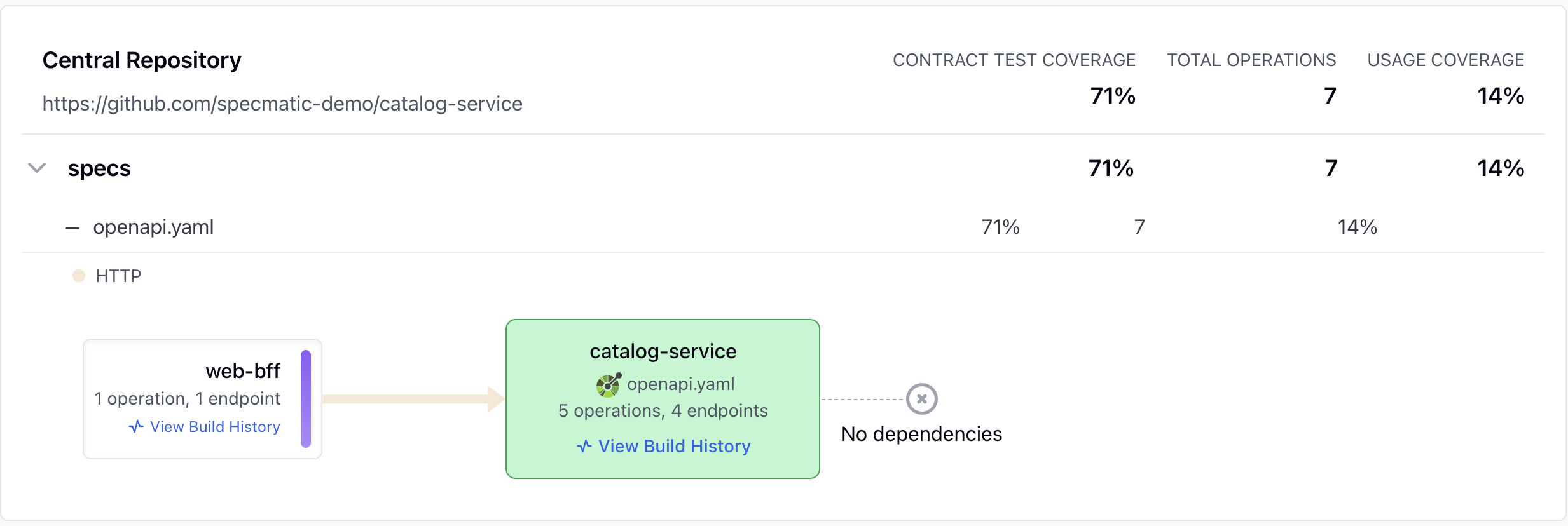
Catalog Service Spec Repository Block
Since catalog-service has the openapi.yaml spec in its specs/ folder, Insights shows one row for that spec inside the Spec Repository block.
Once the catalog-service service build report is processed, Insights identifies catalog-service as the provider for that spec and displays it as the center block.
Once a consumer build such as web-bff is processed, Insights links that consumer to the same spec and displays it on the left-hand side.
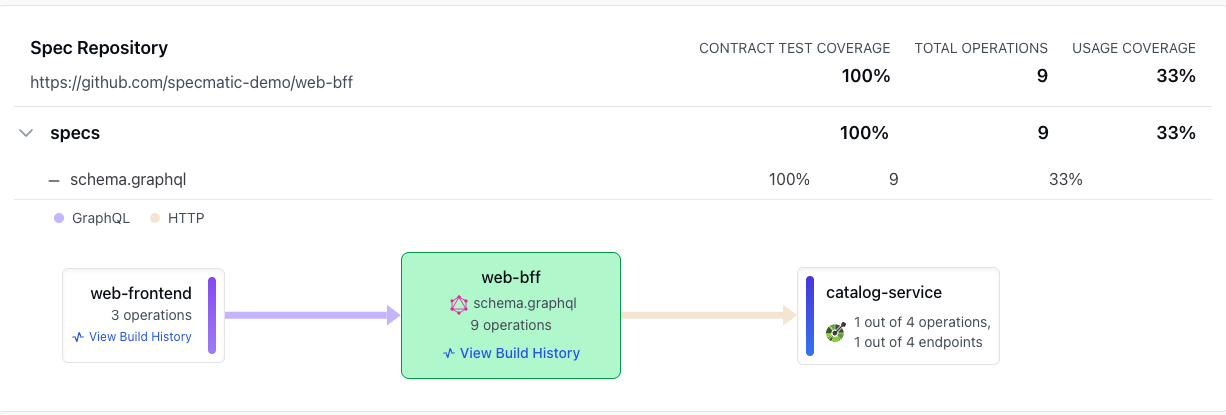
Web Bff Spec Repository Block
Since web-bff has the schema.graphql spec in its own specs/ folder, its Spec Metadata Report creates a separate Spec Repository block for that GraphQL spec.
When the web-bff service build report is processed, Insights identifies web-bff as the provider for schema.graphql and displays it as the center block.
When a consumer build such as web-frontend is processed, Insights links that consumer to the web-bff contract and shows it on the left-hand side.
At the same time, because web-bff also consumes the catalog-service contract, the view shows catalog-service on the right-hand side as a dependency that web-bff is using.
To learn more about Insights stats, see Insights Stats Overview.
Troubleshooting
The provider service is missing in Insights
Check that:
- the
spec-metadata-reportwas generated from the provider repository and posted to Insights - the provider contract test suite was run and the service build report was posted to Insights
- when running the provider contract test suite, the repository Git root was mounted into the container
The consumer service is missing in Insights
Check that:
- the consumer points to the provider repository and the correct spec path
- the provider's
spec-metadata-reportwas generated and posted to Insights - the consumer contract test suite was run and the consumer service build report was posted to Insights
- when running the consumer contract test suite, the repository Git root was mounted into the container